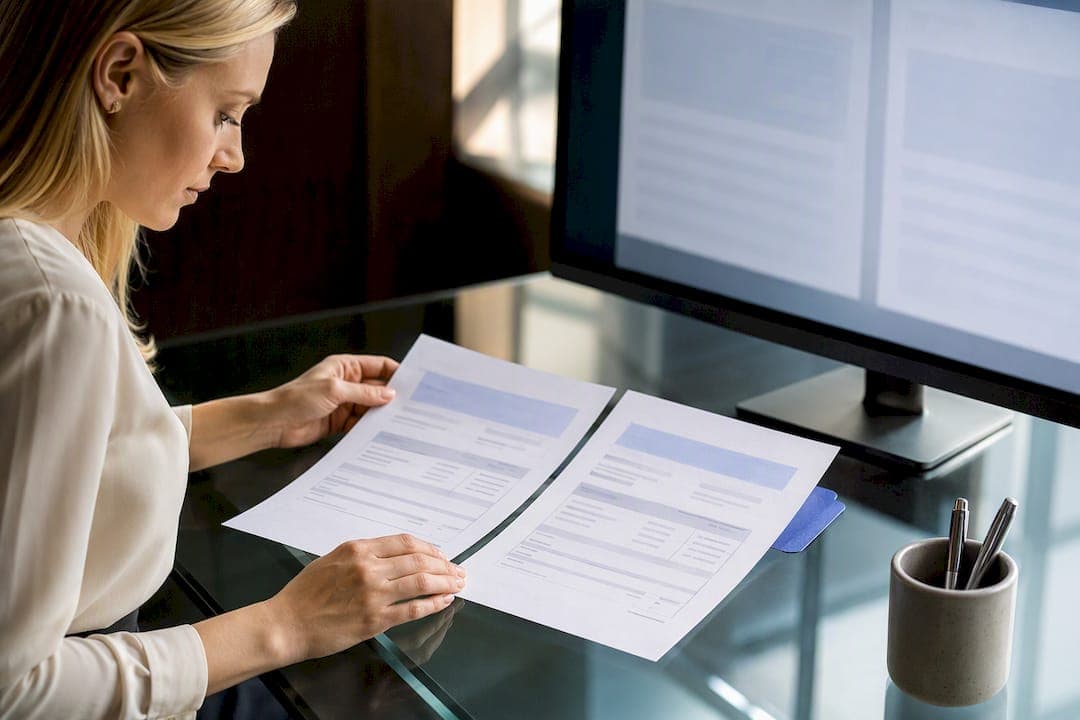
The quickest privacy-safe way to compare invoice files is to run a local OCR and text-diff workflow, then confirm unresolved items with a visual side-by-side check, all on copies stored on your own machine. Tools like LawtonPDF handle this entirely on-device, so nothing leaves your computer. The result is a set of flagged discrepancies, a comparison report, and an audit trail you can hand to a reviewer without exposing sensitive files.
TL;DR:
- Using OCR for image-only invoices requires human review and correction to avoid transcription errors that affect comparison accuracy.
- Comparing signed or scanned invoices must account for pixel shifts caused by re-scanning or re-signing, making digital signatures a better option when available.
- Running automated text diffs first and then visually reviewing only flagged pages significantly speeds up the process and reduces unnecessary image checks.
- Maintaining an audit trail with original files, comparison reports, checksums, and metadata is essential for verifying discrepancies during legal or financial reviews.
- Local-only comparison tools eliminate the privacy risks of cloud uploads and better meet compliance standards for sensitive invoice data.
Table of Contents
- Quick checklist: step-by-step workflow to compare invoices locally
- Preparing files for reliable comparisons
- Comparison methods and when to use each one
- Special handling for scanned or signed invoices
- Documenting differences for audits and internal controls
- Privacy-first controls: keeping invoice data off other people's servers
- What working with regulated teams has taught me
- LawtonPDF: local-first tools built for this exact workflow
- Sources
- FAQ
Quick checklist: step-by-step workflow to compare invoices locally
Before you touch a diff tool, protect the source documents. Everything else builds on that first step.
- Duplicate the originals. Work only on copies so the source invoices stay untouched for evidentiary purposes.
- Run OCR on image-only files. If a PDF has no text layer, convert it to a searchable PDF and check a sample of pages for accuracy before trusting the output.
- Normalize the format. Fix page rotation, standardize page size, and extract text layers where they already exist.
- Run a text-based diff first. Let the tool match identical content automatically and flag anything that does not line up.
- Visually review flagged items. Open only the pages the diff marked as different, rather than eyeballing every page.
- Export the comparison report. Save the report alongside checksums, the tool name and version, the operator's name, and a timestamp.
- Package the audit files. Keep the copies, the report, and the metadata together in one folder for later reference.
This order matters because it filters out noise early. A text diff catches line-item and numeric changes fast, so your visual review time goes only to pages that actually need a second look.
Preparing files for reliable comparisons
Bad input produces bad diffs, and most comparison errors trace back to preparation, not the tool itself.
OCR accuracy is the biggest variable. Machine-generated transcriptions are not always accurate, and NARA's OCR transcription guidance notes that human review and correction are needed before you treat OCR text as reliable. Skipping that check is how a smudged "3" becomes an "8" in your comparison report.
A few habits reduce these errors before they start:
- Scan at a higher resolution when line items are dense. Fine print and small totals need more detail than a quick low-resolution scan provides.
- Choose grayscale for text-heavy invoices and reserve color scanning for documents where color carries information, such as stamps or highlighted approvals.
- Save as searchable PDF for working copies and keep TIFF versions for long-term archival storage when that is your organization's practice.
- Never edit the original bitmap. Any correction, cropping, or compression should happen on a duplicate, not the source file.
- Ask for the native electronic invoice when you can. A vendor's original PDF or spreadsheet avoids OCR altogether and removes a whole category of error.
When a vendor can send the native file, request it. OCR is a workaround, not a first choice.
Comparison methods and when to use each one
Not every discrepancy shows up the same way, so a single method will miss things another method catches.
- Text and OCR diffs work best for numeric and line-item changes such as a shifted quantity, a revised unit price, or an altered invoice number, provided the OCR output has already been checked for accuracy.
- Visual pixel diffs catch layout changes, added annotations, or the presence of a signature, but they generate noise on re-scans where slight misalignment or shading differences trigger false flags.
- Metadata and checksum checks confirm quickly whether two files are identical or whether one has been altered since it was received, without opening either document.
- A layered approach beats any single method. Run the automated text diff across the whole batch first, then send only the flagged pages through a visual check, which keeps the process fast without giving up accuracy.
Treat these as complementary steps rather than competing options. A checksum tells you a file changed; a text diff tells you where; a visual check tells you whether the change actually matters.
Special handling for scanned or signed invoices
Signed and scanned invoices deserve extra care because the scanning process itself introduces variation that has nothing to do with the invoice content.
- Expect noise from print-scan-sign cycles. Comparing a scanned signed invoice against an earlier version often produces unreliable diffs, since re-scanning and re-signing shift pixels even when the underlying numbers match, which is why digital signature workflows are recommended wherever they are available.
- Log provenance for every copy. Note who handled each file, when it was scanned or converted, and what transformations were applied.
- Keep original bitmaps untouched. Perform OCR, cropping, or compression on a duplicate and record every step you took.
- Escalate when the stakes are high. For a dispute that may go to legal proceedings, request the native file from the sender or bring in a forensic imaging specialist rather than relying on a standard scan comparison.
Documenting differences for audits and internal controls
A comparison result is only as useful as the record you keep of how you reached it.
- Build a full audit package. Include the original file copies, the exported comparison report, relevant screenshots, checksums, the tool and version used, the operator's name, timestamps, and the settings applied.
- Sample large batches instead of reviewing every file by hand. NARA's quality management guidance recommends drawing a statistically valid sample, such as ten files or a statistically valid small sample of a batch, for manual QC after automated checks are complete.
- Adopt a consistent file-naming convention so any reviewer can trace a report back to its source files without guesswork.
- Store the package on local, access-controlled storage rather than a shared drive with broad permissions.
These records matter most when someone asks, months later, why a payment was flagged or released. A dated, named, checksummed package answers that question without requiring anyone to remember the details.
Privacy-first controls: keeping invoice data off other people's servers
Every upload to a cloud comparison tool is a copy of a sensitive document leaving your control. NIST SP 800-88 Rev. 2 frames this as a risk-based handling problem: the more systems a file touches, the more places it can be exposed or retained without your knowledge. Keeping processing local removes most of that exposure by default.
A few operational habits reinforce this:
- Check your tool's settings before a batch run. Confirm uploads and telemetry are disabled, not just assumed to be off.
- Use an air-gapped machine for your most sensitive files rather than trusting a network-connected one to behave.
- Document your sanitization steps for any device that previously held sensitive files, in line with the same NIST guidance.
Pro Tip: Run a small batch of test invoices and watch your network monitor before processing a full folder, so you confirm no data leaves the machine before it matters.
Comparison tools that run entirely on local hardware satisfy this control by design rather than by configuration.

What working with regulated teams has taught me
The most common mistake I see is teams trusting a visual diff on re-scanned documents and missing that the noise is coming from the scan process, not the invoice. A close second is skipping OCR validation and treating machine transcription as fact. Teams that adopt a documented local workflow resolve disputes faster and avoid the privacy incidents that come from routing sensitive files through third-party servers. Build the checklist once, request native files when you can, and the rest gets easier.
— Lawton
LawtonPDF: local-first tools built for this exact workflow
If the checklist above is the process, LawtonPDF is a way to run it without juggling separate scanning, OCR, and diff tools. It compares PDF, Word, spreadsheet, image, and folder contents entirely on your computer, with OCR support for scanned invoices and exportable reports you can drop straight into an audit package.
- Compare invoice files side by side with dedicated PDF comparison tools built for legal and financial documents.
- Turn scanned invoices into searchable PDFs locally, without uploading a single page.
- Choose a plan for team licensing, or start with a free tier to test the workflow.
Check the Plus, Business, and Free plans to find the right fit for your team, or explore the full toolset to see what else runs locally alongside comparison.
Sources
This workflow draws on NIST SP 800-88 Rev. 2 for media handling, NARA's digitization guidance for quality control, and NIST IR 8053 on de-identification risk.
FAQ
What is the fastest way to compare invoices for discrepancies?
Run a text or OCR diff first to catch numeric and line-item changes automatically, then review only the flagged pages visually. This layered approach is faster than checking every page by hand and catches more than a visual check alone.
How accurate is OCR for comparing scanned invoices?
OCR transcription is machine generated and not always accurate, which is why NARA's guidance recommends human review before treating the text as final. Validating a sample of OCR output before running a full diff catches most transcription errors early.
Why do scanned signed invoices produce unreliable comparisons?
Print, scan, and sign cycles shift pixels and introduce visual noise even when the underlying numbers are identical, which makes pixel-based diffs unreliable on these files. Digital signature workflows avoid this problem and are recommended when a vendor can provide them.
Is cloud-based invoice comparison software a privacy risk?
Uploading invoices to a cloud tool means the file leaves your control and touches systems you cannot audit directly, which increases exposure risk under NIST's media handling guidance. Local-only tools such as LawtonPDF avoid this by processing files entirely on your own computer.
What should an invoice comparison audit trail include?
An audit package should include the original file copies, the exported comparison report, checksums, the tool and version used, the operator's name, and timestamps. For large batches, sampling a portion of files for manual QC, as NARA's digitization guidance recommends, keeps review times reasonable without skipping verification.