
Data leakage is defined as the unauthorized exposure or transmission of sensitive information from inside an organization to unauthorized person, system, or external destination, whether through malicious action, misconfiguration, or simple human error. For legal, finance, healthcare, and tech teams, the consequences are severe: regulatory penalties under HIPAA, GDPR, and PCI-DSS, plus reputational damage that takes years to repair. The industry term for the discipline that addresses this risk is Data Loss Prevention, or DLP. Implementing DLP requires layered controls, not a single tool. Multi-Factor Authentication alone blocks the majority of unauthorized access attempts, and it is the single highest-impact control available to any organization today.
What are the essential technical controls to prevent data leakage?
Technical controls form the foundation of any serious data loss prevention strategy. Without them, policy documents and training programs have nothing to enforce.
1. Deploy Multi-Factor Authentication across every access point

Multi-Factor Authentication (MFA) is widely recognized as one of the most effective security controls for preventing unauthorized access. Every external-facing system—including VPNs, email platforms, cloud services, and remote access portals—should require MFA before granting access. Treat MFA as a baseline security requirement rather than an optional best practice.
2. Enforce strict patch management SLAs
Unpatched vulnerabilities are the most predictable attack surface in any environment. Security leaders recommend patching critical vulnerabilities within 48 hours, high-severity issues within 2 weeks, and medium-severity issues within 30 days. Organizations that miss these windows give attackers a documented, public roadmap to their systems.
3. Encrypt data at rest and in transit
Encryption renders data unreadable without the encryption key, even when a breach occurs. Many regulatory frameworks, including GDPR, treat encrypted data breaches as lower-severity incidents. Encryption is not a prevention control alone. It is a fallback that limits the damage when other controls fail.
4. Apply network segmentation and least-privilege access
Network segmentation limits how far an attacker can move after gaining initial access. Least-privilege access ensures that employees, contractors, and service accounts can only reach the data their role requires. Both controls reduce the blast radius of any single compromised credential.
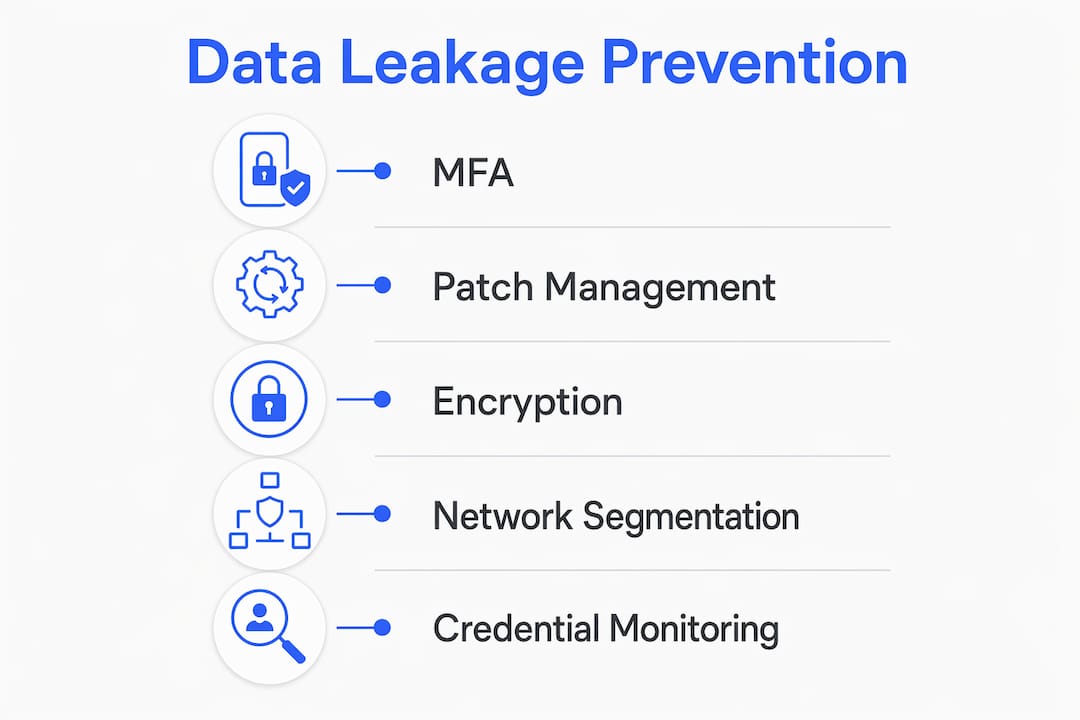
5. Monitor credentials on dark web and infostealer logs
Credentials captured on infected devices are sold on criminal markets within hours. Proactive monitoring of infostealer logs lets security teams detect stolen credentials before attackers use them. Early detection enables immediate password resets, which breaks the attack chain before a breach begins.
Pro Tip: Pair credential monitoring with behavioral analytics. When a user’s login pattern suddenly shifts, such as accessing systems at unusual hours or from new geographies, flag it for review immediately rather than waiting for an alert threshold to trigger.
How does AI introduce new data leakage risks?
AI tools create a category of data leakage risk that traditional DLP systems were not designed to address. Understanding the mechanics is the first step toward controlling the exposure.
The core problem is what security researchers call the lethal trifecta for AI data leaks: access to private data, untrusted input, and an outbound channel. When all three conditions exist simultaneously, sensitive information can exit your environment through an AI model’s response, a connected API, or an automated workflow. Removing any one of the three conditions breaks the chain.
Practical mitigations for AI-specific leakage include:
-
AI-specific DLP solutions: These tools scan prompts, file uploads, and pasted content in real time, redacting PII, source code, and confidential data before it reaches an AI endpoint. Standard DLP tools miss this vector entirely.
-
Architectural separation: Keep AI agents, private data stores, and outbound channels isolated from each other. An AI agent that cannot directly query your client database cannot leak what it cannot access.
-
Vendor security vetting: Before deploying any third-party AI tool, require documentation of data retention policies, training data practices, and SOC 2 or ISO 27001 certification.
-
Shadow AI detection: Employees regularly adopt AI tools without IT approval. Behavioral monitoring that flags unusual outbound traffic to AI endpoints catches shadow AI before it becomes a liability.
-
Generative AI firewalls: These sit between users and AI endpoints, enforcing content policies and blocking policy violations in real time.
Pro Tip: Separate AI agent functions by role and data scope. An AI agent that handles customer service queries should have zero access to financial records, even if both systems sit on the same network.
AI data leakage requires governance models that go beyond traditional DLP. Prompt injection attacks, where malicious input manipulates an AI model into revealing private data, require controls at the architectural level, not just the policy level.
What organizational policies strengthen data leakage prevention?
Technical controls only work when organizational policies define what they protect and who they apply to. Policy without enforcement is decoration. Enforcement without policy is chaos.
Data classification is the starting point. DLP works best when matched to classified sensitive data. Every organization should define at least three tiers: public, internal, and confidential. Each tier gets a corresponding set of handling rules, access restrictions, and transmission controls.
Access management translates classification into practice. Role-Based Access Control (RBAC) assigns permissions based on job function. Privileged Access Management (PAM) adds a second layer of oversight for accounts with elevated rights, such as database administrators and system engineers. Both reduce the number of people who can touch your most sensitive data.
Effective organizational policies also include:
-
Employee training on phishing and safe data handling: Human error causes a significant share of data leakage incidents. Regular, scenario-based training reduces the likelihood that an employee forwards a sensitive document to the wrong recipient or clicks a credential-harvesting link.
-
Offboarding procedures with immediate access revocation: Departing employees represent a real and documented risk. Access to all systems, including cloud services and shared drives, must be revoked on the employee’s last day, not the following week.
-
Incident response planning with tabletop exercises: Organizations with tested response plans contain breaches faster and limit damage more effectively than those without. Run tabletop exercises at least twice per year to expose gaps before an actual incident does.
-
Continuous risk assessment: Threat landscapes shift. Quarterly reviews of your data classification, access controls, and DLP policies keep your defenses current.
A layered, defense-in-depth approach that combines credential monitoring, access management, and behavioral analytics reduces both the frequency and severity of successful breaches. No single control is sufficient on its own.
How do you monitor and respond to data leakage incidents?
Detection speed determines how much damage a breach causes. The faster you identify an incident, the less data exits your environment.
| Monitoring Tool | Primary Function | Key Benefit |
|---|---|---|
| SIEM (Security Information and Event Management) | Correlates logs across systems to detect anomalies | Centralized visibility across the entire environment |
| SOAR (Security Orchestration, Automation, and Response) | Automates response workflows triggered by SIEM alerts | Reduces mean time to respond |
| EDR (Endpoint Detection and Response) | Monitors endpoint behavior for malicious activity | Catches threats that bypass perimeter controls |
| Dark web monitoring | Scans criminal markets for stolen credentials | Enables proactive resets before credentials are used |
| Behavioral analytics | Detects anomalous user activity patterns | Identifies insider threats and compromised accounts |
Detailed logging is a prerequisite for forensic readiness. Every access event, permission change, and file transfer should generate a log entry with a timestamp, user ID, and system identifier. Without this data, post-incident investigation becomes guesswork.
Patch management adherence ties directly into detection. Systems running known-vulnerable software generate alerts that security teams often deprioritize. Maintaining the 48-hour SLA for critical patches eliminates the most exploitable gaps before attackers find them.
Test your incident response plan on a schedule. A plan that has never been exercised will fail under the pressure of a real event. Tabletop exercises reveal procedural gaps, unclear ownership, and communication breakdowns that are easy to fix in a drill and catastrophic to discover mid-breach.
Key Takeaways
Preventing data leakage requires a combination of technical controls, organizational policy, and continuous monitoring. No single measure is sufficient without the others.
| Point | Details |
|---|---|
| MFA is the top control | 82% of denied cyber insurance claims in 2024 involved organizations without MFA. |
| Patch on a strict SLA | Critical vulnerabilities must be patched within 48 hours to close the most exploitable gaps. |
| AI requires new DLP models | AI-specific DLP and architectural separation address prompt injection and outbound channel risks. |
| Classify data before protecting it | DLP policies are most effective when matched to a defined data classification framework. |
| Test your response plan | Organizations with regularly exercised incident response plans contain breaches faster. |
Common mistakes organizations make
Many organizations treat data leakage prevention as a compliance checklist rather than an ongoing security program. Deploying Multi-Factor Authentication (MFA) is an essential first step, but it does not eliminate every risk. Modern threats, including infostealer malware and stolen session tokens, can allow attackers to access authenticated sessions in certain scenarios. This is why organizations should combine MFA with endpoint protection, continuous monitoring, and strong identity security.
The risks introduced by generative AI are also frequently underestimated. Employees may begin using public AI tools without formal approval, unintentionally sharing confidential contracts, financial records, source code, or other sensitive information. Effective AI governance requires clear policies, approved tools, user education, and technical controls that help prevent sensitive data from being exposed.
A strong security posture combines multiple layers of protection, including continuous monitoring, least-privilege access controls, regular security reviews, and ongoing employee awareness training. Technical controls are most effective when employees understand why they exist and how they help protect both the organization and its clients.
Security should support productivity rather than slow it down. When secure tools are easy to use, employees are far more likely to adopt them. For example, using an offline document comparison solution like LawtonPDF allows professionals to review sensitive documents locally without uploading confidential information to external services, helping reduce unnecessary data exposure while maintaining an efficient workflow.
Lawtonpdf: offline document security for regulated teams
Document comparison is a routine task in legal, finance, and healthcare workflows. It is also a common source of unintentional data leakage, especially when teams use cloud-based tools that process sensitive files on external servers.
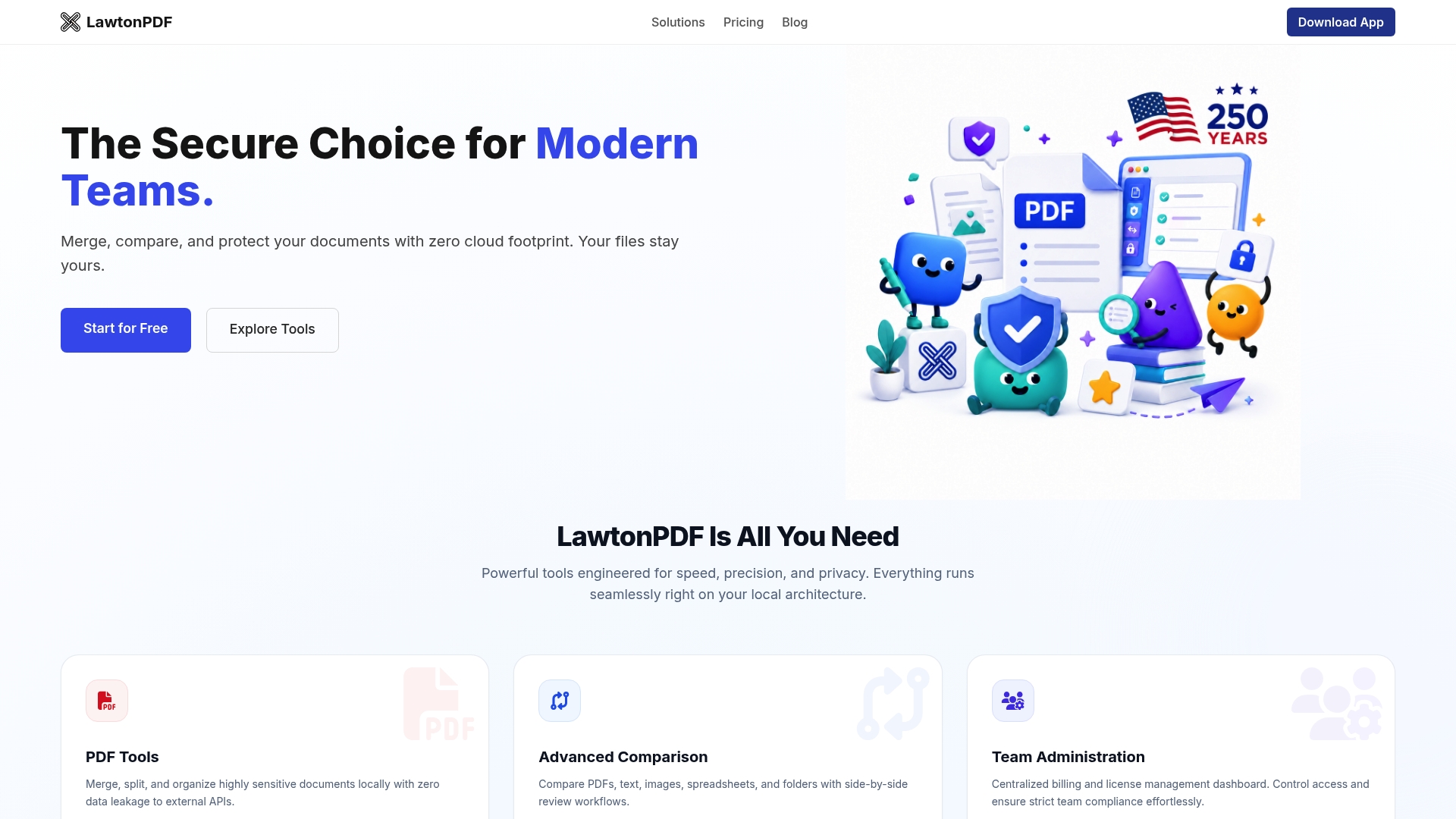
LawtonPDF processes documents locally on your computer using its Local Engine, so document content remains on your system instead of being uploaded to cloud services for processing. By keeping sensitive files within your organization's environment, LawtonPDF helps reduce the risks associated with cloud-based document handling and supports organizations with strict privacy and compliance requirements. For legal professionals, financial institutions, healthcare providers, and other organizations working with confidential information, local document comparison provides a secure and efficient way to review files while maintaining control over sensitive data. If your organization prioritizes privacy, LawtonPDF offers a practical alternative to cloud-based document comparison workflows.
FAQ
What is data leakage in cybersecurity?
Data leakage is the unauthorized exposure or transmission of sensitive information to an unauthorized person, system, or external destination. It can result from cyberattacks, misconfigurations, third-party vulnerabilities, or human error. Organizations reduce this risk through Data Loss Prevention (DLP) strategies, security controls, and employee awareness.
Why is Multi-Factor Authentication (MFA) important for preventing data breaches?
Multi-Factor Authentication (MFA) adds an additional layer of verification beyond a password, making unauthorized account access significantly more difficult even if credentials are compromised. It is widely recognized as one of the most effective foundational security controls.
How does AI create new data leakage risks?
AI tools can increase the risk of data leakage when sensitive information is submitted to external AI services or when AI systems have access to confidential data without appropriate safeguards. Organizations should implement AI governance, access controls, and monitoring to help protect sensitive information.
Why is patch management important for preventing data leakage?
Keeping software up to date helps protect systems from publicly known vulnerabilities that attackers may exploit. A risk-based vulnerability management process that prioritizes critical security updates is an essential part of any cybersecurity program.
How does LawtonPDF help reduce data leakage risk?
LawtonPDF processes documents locally using its Local Engine, so files remain on your computer instead of being uploaded to cloud services for processing. By keeping document comparison on your own system, organizations can reduce the risks associated with cloud-based document handling while maintaining greater control over sensitive information.