
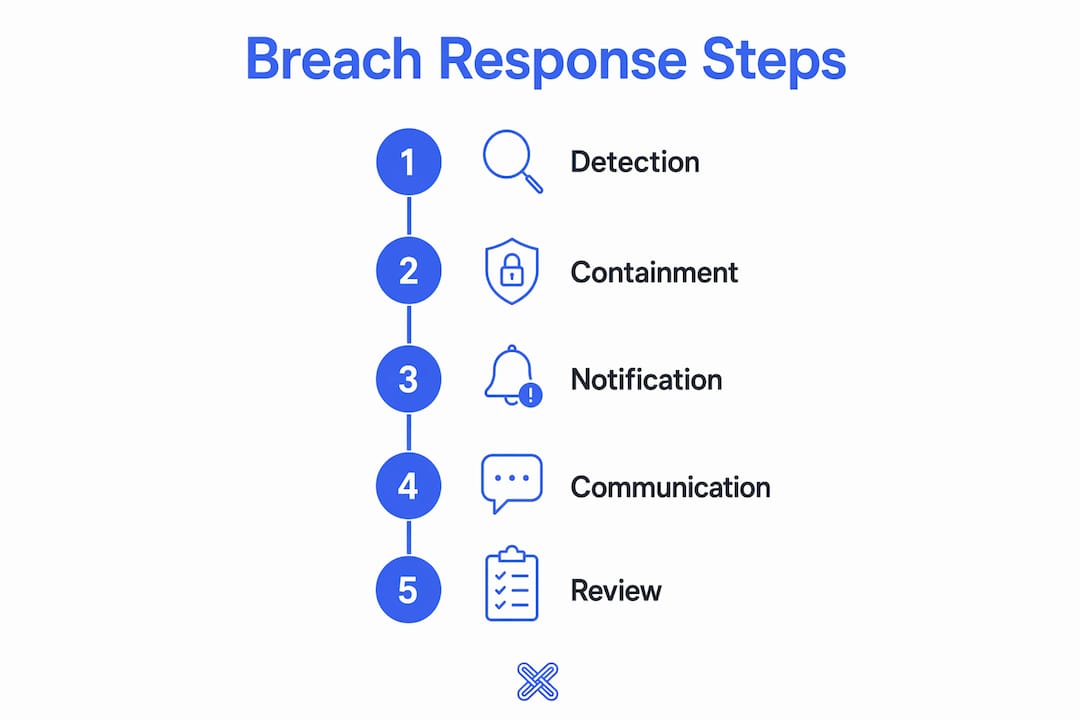
A data breach response plan is a documented set of procedures your organization follows the moment unauthorized access to sensitive data is detected. Done right, it limits damage, preserves evidence, and keeps you on the right side of US federal and state law. The core phases are preparation, detection, containment, notification, and post-incident review. FTC guidelines treat these phases as foundational, and legal counsel should be part of the process from the very first hour, not just when notification letters go out.
A solid plan covers:
- A named incident response team with defined roles
- Pre-approved containment actions that do not require real-time legal sign-off
- Notification timelines tied to HIPAA and applicable state laws
- Evidence preservation and legal hold procedures
- A post-incident review process to close gaps
Table of Contents
- What does an effective data breach response plan include?
- How do US breach notification laws affect your timeline?
- What are the best practices for communicating after a breach?
- How does local document management support breach response?
- How do you improve your response plan after an incident?
- Which cybersecurity tools support breach detection and response?
- Key Takeaways
What does an effective data breach response plan include?
Your incident response team is the backbone of any breach protocol. FTC guidance recommends assembling forensics, legal counsel, IT, HR, communications, and management as soon as a breach is discovered. Each role needs a clearly documented scope of authority, especially over containment decisions, so no one is waiting for permission while the clock runs.
Key structural elements include:
- Incident commander: Owns decisions and tempo; coordinates all workstreams
- Legal counsel: Engaged immediately to protect forensic findings under attorney-client privilege and assess notification obligations
- Forensics team: Captures system images, analyzes logs, and outlines remediation steps
- Communications lead: Manages internal and external messaging
- Privacy officer: Tracks notification deadlines and regulatory filings
Containment is where most organizations lose time. NIST SP 800-61r2 is direct on this: isolate affected hosts at the network layer rather than shutting them down. Powering off a machine destroys volatile memory, which often holds the clearest evidence of how the breach happened and how far it spread. Pre-defining which technical containment actions your IT team can take autonomously, and which ones need counsel on the line first, eliminates the confusion that typically consumes the first 24 hours.
Staff training ties everything together. Tabletop exercise checklists, run quarterly or after any near-miss, let your team practice the decision points before they face them under pressure. Document every action taken during a breach. Regulators may request evidence months after the incident, and a legal hold initiated on day one is your primary defense against adverse inferences later.
How do US breach notification laws affect your timeline?
There is no single federal notification deadline. HIPAA requires covered entities to notify the Department of Health and Human Services and affected individuals within specific timeframes after discovering a breach, with the exact window depending on the number of people affected. State laws add another layer: most set their own deadlines, and some require notification within a short timeframe after discovery.
A critical point that many organizations miss: notification clocks start at awareness, not at the conclusion of your investigation. You do not need a complete forensic picture before filing an initial report. Submit what you know, then follow up as more details emerge. Delaying notification to gather full information is one of the most common compliance mistakes teams make.
Your breach notification procedure should account for:
- HHS: Required for HIPAA-covered entities; timeline depends on breach scope
- State attorneys general: Most states require separate notification; deadlines vary
- FTC: Relevant for financial institutions under the Gramm-Leach-Bliley Act
- Law enforcement: Notify local police or the FBI early; coordinate timing so notification to individuals does not compromise an active investigation
Involve legal counsel before any written communication leaves your organization. Premature or overly broad disclosures can create additional legal exposure. The goal is a notification that is accurate, complete enough to be useful, and legally vetted.
Pro Tip: Document the exact timestamp when personal data involvement is confirmed. That moment starts your notification clock, and your records are your primary defense if a regulator later questions your timing.
What are the best practices for communicating after a breach?
Appoint a single point of contact for all external communications before a breach ever happens. When an incident occurs, that person owns every statement that goes out, from the initial internal alert to the customer notification letter. Inconsistent messaging across departments is one of the fastest ways to turn a manageable incident into a reputational crisis.

Public statements must be transparent but legally vetted before release. Broad statements made without counsel review can worsen legal exposure or inadvertently violate state notification laws. Your communications plan should address employees, customers, investors, partners, and regulators separately, because each audience needs different information at different times.
Effective notification letters tell affected individuals:
- What type of information was exposed
- What steps they should take to protect themselves (for example, placing a fraud alert or credit freeze if Social Security numbers were involved)
- How your organization will communicate with them going forward
- That your organization will never call them asking for passwords or payment details related to the breach
That last point matters more than it sounds. Telling people upfront how you will and will not contact them helps them recognize phishing attempts that often follow a publicized breach. Prepared templates for customer letters, press holding statements, and regulator filings reduce errors and speed up the process considerably. Compliance support resources can help you avoid common notification mistakes, particularly when managing multi-state obligations simultaneously.
How does local document management support breach response?
Every document your team creates during a breach response, including forensic notes, containment logs, legal hold notices, and notification drafts, is sensitive. Uploading those files to a cloud service during an active investigation introduces exactly the kind of exposure you are trying to contain.
Lawtonpdf processes all documents locally on your Windows machine. Nothing leaves your hardware. During a breach investigation, that means your evidence logs, comparison reports, and notification drafts stay entirely within your controlled environment. You can use Lawtonpdf's PDF comparison tools to identify changes between document versions, which is useful when reviewing access logs or policy documents for unauthorized modifications.
Watermarking and password protection features let you mark breach-related documents as confidential and restrict access to authorized team members only. That supports chain of custody, a requirement regulators take seriously. The folder comparison feature is particularly practical for checking whether files in a monitored directory have been altered or added since your last review.
Pro Tip: Use Lawtonpdf's watermarking tool to stamp all breach response documents with a "Legal Hold" or "Confidential" label before distributing them internally. This creates a clear audit trail without any cloud processing.
Centralized team administration means your incident response team can work from the same document set without routing files through external services. For organizations that handle sensitive personal data regularly, keeping document workflows local is not just a preference. It is a practical data security best practice.
How do you improve your response plan after an incident?
A post-incident review is where your data breach playbook actually gets better. Conduct it within five business days for high-severity incidents, and include your privacy officer and legal counsel alongside the technical team. Their perspective on how notification went and how regulators responded is as valuable as the root cause analysis.
The review should assess what detection controls caught the breach, what slowed the response, and whether your notification timing held up against regulatory deadlines. From there, update your tabletop exercise checklist to reflect the real scenarios your team encountered. A review that produces specific control changes is worth far more than a lengthy report that sits unread.
Maintain a central breach register that logs every incident, regardless of severity. Reviewing it periodically reveals patterns, repeated vulnerability types, or process gaps that individual incident reviews might miss.
Which cybersecurity tools support breach detection and response?
Detection is where most breaches are won or lost. The NIST Cybersecurity Framework organizes detection and response capabilities around event monitoring, log correlation, and anomaly detection. In practice, your incident response strategy should integrate tools that cover three areas: detecting unauthorized data access, correlating events across systems, and managing credentials when accounts are compromised.
Security information and event management (SIEM) platforms aggregate logs from across your environment and surface anomalies that individual system alerts would miss. Endpoint detection and response (EDR) tools monitor host-level activity and can flag unusual file access or lateral movement. Identity and access management (IAM) controls let you revoke compromised credentials quickly, which is one of the eight containment actions you can take in the first hour without waiting for legal sign-off.
Encryption is your last line of defense if containment fails. Data that is properly encrypted at rest is effectively unusable to an attacker who exfiltrates it. Pair encryption with access logging so you can determine exactly which records were accessed and by whom, a requirement for accurate notification and regulatory filings.
Key Takeaways
A complete data breach response plan combines a trained team, pre-approved procedures, compliant notification timelines, and secure local documentation to minimize damage and regulatory risk.
| Point | Details |
|---|---|
| Assemble your team before a breach | Include forensics, legal, IT, HR, and communications with defined roles and decision authority. |
| Notification clocks start at awareness | File an initial report when you become aware, then follow up as investigation details emerge. |
| Preserve volatile memory | Isolate affected hosts at the network layer rather than shutting them down to protect forensic evidence. |
| Keep breach documents local | Use local-only tools like Lawtonpdf to prevent cloud exposure of sensitive investigation files. |
| Review and update after every incident | Post-incident analysis should produce specific control changes, not just documentation. |